
Sidelock of youth
Ancient Egyptian braided side hair worn by royal children.
The sidelock of youth is a braided hairstyle from Ancient Egypt, worn by royal and divine children to signal their status as heirs. It features a single braid on the side of an otherwise shaved head, linking the wearer to the god Horus.
- Worn by royal children to show they were heirs of Osiris.
- Consists of a braid on an otherwise shaved head.
- Revived by pharaohs Amenhotep I and Thutmoses III.
- Linked to the god Horus and his role as successor.
What it is
This style features a single braid hanging from the side of the head, while the rest of the scalp is shaved bare. The braid is typically formed from three strands of hair that converge and twist into a spiral at the end. It was worn by both mortal and divine children in Ancient Egypt. Although called a lock, it is technically a braid. The length varied from short to shoulder-length, often attached to a wig in later periods. The braid was usually positioned on the right side, though artistic depictions sometimes placed it on the left for visibility in profile views.
Where it comes from
The style emerged during the Old Kingdom as a divine attribute. Egyptologists named it the sidelock of youth due to its strong association with children. In the Middle Kingdom, the braid end was often rolled toward the front. Pharaohs Amenhotep I and Thutmoses III revived this specific Middle Kingdom form during the New Kingdom. The style regained prominence in the Late Period. During the 18th Dynasty, it became a central symbol for princes and princesses, marking them as designated heirs to the throne.
What it means
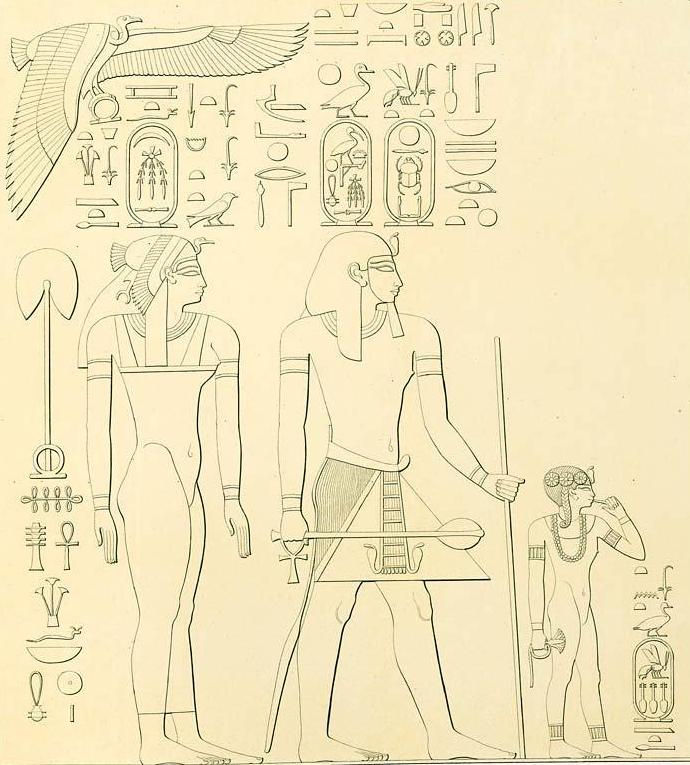
The braid served as a visual marker of legitimacy, identifying the wearer as a rightful heir of Osiris. It connected royal children to the youthful god Horus, who wore the same style as his father’s successor. This mythological link highlighted the special duties and status bound to the child’s position. Iconography often showed these children naked and sucking their fingers, with only the sidelock remaining on their shaved heads. The style signified both childhood and divine right to rule.
How it is made
A section of hair is separated from the side of the skull. This section is divided into three individual strands. These strands are braided together and secured at the root with a clasp. The end of the braid is twisted into a spiral shape. In some variations, the hair between the clasp and the spiral remains loose. For divine representations linked to the goddess Mafdet, the braid may terminate in a claw-like shape rather than a simple spiral.
Who and what it suits
It was historically worn by children in Ancient Egypt, regardless of their natural hair type, as it was often part of a wig or styled on shaved heads. The look is defined by its cultural and ritual context rather than modern aesthetic suitability.
Versions
Variations include the triple braided sidelock, where three strands merge into a spiral. Another type is the Horus lock, which also uses three strands but ends in a claw-like shape associated with the goddess Mafdet. Some versions feature a clasp at the origin with a loose lock of hair leading to a spiral end. Wigs wearing the sidelock appeared in curled, straight, or tressed styles.
In culture
The sidelock appears in mortuary cult depictions and royal iconography. It is closely tied to the myth of Horus and Osiris. Notable figures depicted with this style include Amenhotep I, Thutmoses III, and Khaemwaset, son of Rameses II. The style reflects the intersection of royalty, religion, and childhood in Ancient Egyptian society. It serves as a key identifier in art history for distinguishing royal children from other figures.
Questions people ask about Sidelock of youth
Is the sidelock of youth a lock or a braid?
Despite its name, it is usually a braid made from three strands of hair. The end is twisted into a spiral. Egyptologists coined the term sidelock of youth because of its association with children, but the structure is braided.
Who wore the sidelock of youth in Ancient Egypt?
It was worn by both mortal and divine children. Specifically, it identified the children of pharaohs as legitimate heirs. Princesses and princes of the 18th Dynasty frequently wore it to signal their status as probable successors to the throne.
What is the mythological meaning of the Horus lock?
The lock connects the wearer to the youthful god Horus, who wore it as the heir apparent of his father Osiris. By wearing it, royal children indicated their own connection to Horus and their special duties as designated heirs to the kingdom.
Good reading and sources
- Sidelock of youth on WikipediaEncyclopedia
- More photos on Wikimedia CommonsPhotos
- Wikidata recordOpen data
The facts on this page come from the Wikipedia article "Sidelock of youth", written by its contributors and used under the CC BY-SA 4.0 licence, and from its Wikidata record (CC0). EveryHairstyle rewrote the text in its own words, with AI assistance, and compares every page with the article to make sure no passage is copied. It may be reused under the same CC BY-SA 4.0 licence with a link back.
It may contain mistakes, and figures change over time. Nothing here is investment or buying advice. If something is wrong, tell us. Last refreshed 2026-11-15.
Like Sidelock of youth
All braids and plaits 🇮🇳 IndiaHead shaving in Hinduism
A ritual act of head shaving in Hinduism for purification, mourning, and devotion.Shaved · Any hair
 🇮🇳 IndiaTonsure
A religious practice of cutting or shaving scalp hair to signal devotion, humility, or clerical status.Shaved · Any hair
 🇮🇳 India and 2 moreFirst haircut
A rite of passage marking a child's first hair cutting across various cultures and faiths.Shaved · Any hair
 🇮🇳 IndiaShikha
A traditional Hindu tuft of hair kept at the crown after shaving the rest of the head.Shaved · Any hair