
Liberty spikes
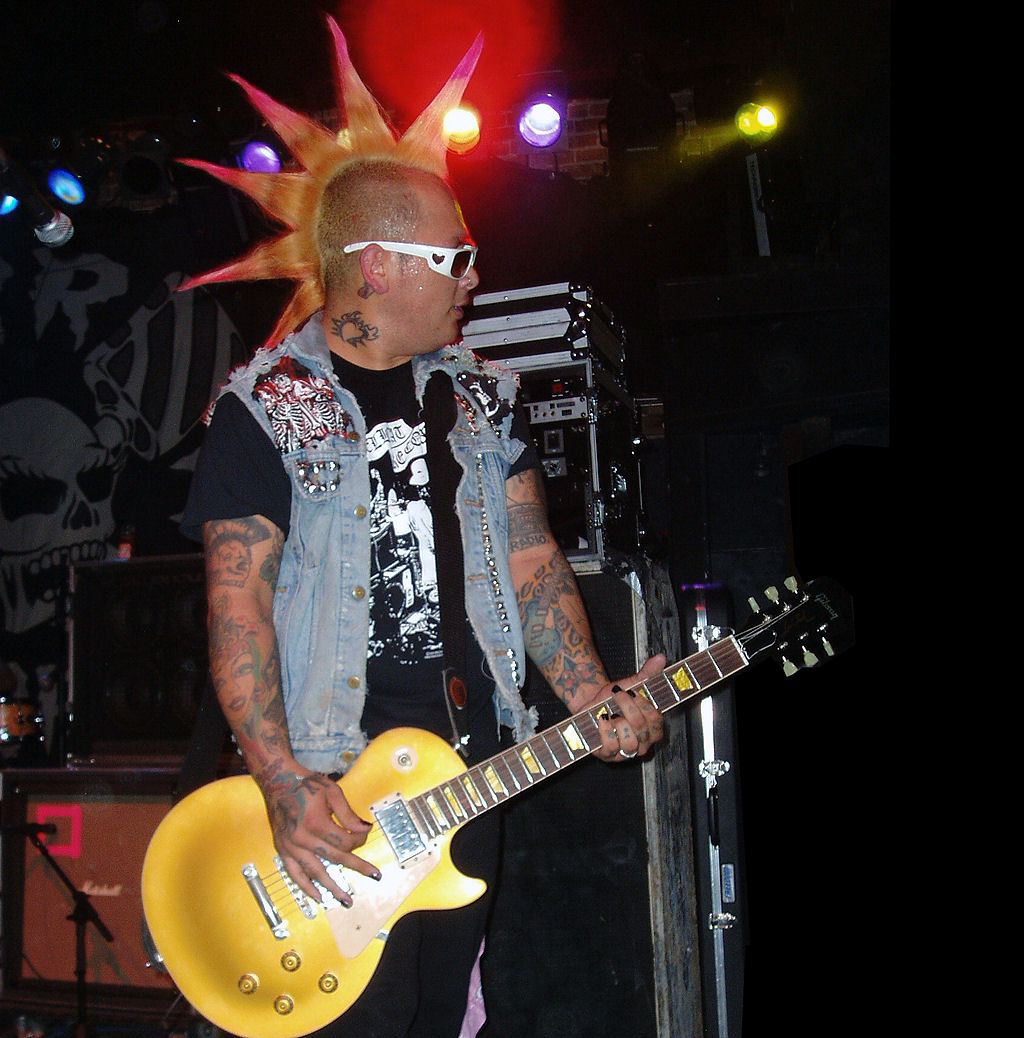
Long, thick upright hair spikes resembling the Statue of Liberty crown.
Liberty spikes are a dramatic hairstyle featuring long, stiffened hair arranged into tall, vertical points. Originating from ancient Celtic warrior traditions and revived by the 1970s punk movement, this style serves as a bold statement of subcultural identity. It requires significant styling effort and strong hold products to maintain its distinctive, radiating shape.
- Named after the Statue of Liberty's crown
- Origins trace back to Ancient Briton warriors
- Can take up to two hours to style
- Popular in punk and goth subcultures
- Spikes can exceed one foot in length
What it is
This style consists of long, thick sections of hair that are stiffened and directed upwards. The spikes may point straight up or radiate outwards from the head. It is distinct from smaller, choppy punk spikes due to its height and volume, often exceeding thirty centimetres. Wearers in the goth scene typically dye their hair black, while punk adherents prefer bright, unnatural colours. The look is durable and can remain intact for several days or even weeks without restyling.
Where it comes from
The practice traces back to Ancient Britons who bleached their hair with lime water and spiked it as a badge of honour. Warriors were forbidden to cut or spike their hair until they had killed an enemy. After Roman conquest, the style vanished. It re-emerged in the 1970s within the British punk subculture as a reaction against smooth hippie and disco hairstyles. By the 1980s, the small initial spikes evolved into the towering liberty spikes seen today. Salvador Dalí also experimented with similar looks in the 1950s.
What it means
For ancient Celts, the hairstyle symbolised manhood and martial success. In modern times, it acts as a visual marker for punk and goth subcultures, representing rebellion and nonconformity. The name references the diadem worn by the Statue of Liberty, linking the aggressive aesthetic to symbols of freedom. It distinguishes the wearer from mainstream fashion norms through extreme height and artificial colouring.
How it is made
Hair is separated into thick sections and coated with strong holding agents capable of supporting significant weight. Standard products designed for natural looks often fail to hold these structures. The spikes are then shaped to point upwards or outwards. A variation known as the crown uses only front spikes to mimic the Statue of Liberty’s headdress. This specific arrangement can take one to two hours to create and is noted for being uncomfortable during sleep.
Who and what it suits
The style is favoured for those with extremely long hair, as length provides the necessary material for thick spikes. It works with any hair texture provided sufficient product is used. While historically associated with male warriors, it is now worn by people of all genders within alternative music scenes. The dramatic verticality draws attention upward, altering the perceived silhouette of the head.
Versions
The most common variation is the crown, which utilises only the front section of hair to create a semi-circular array of spikes. This differs from a full mohawk where the sides are shaved. Punk versions often feature vibrant dyes, whereas goth interpretations tend towards black. Some modern pop-punk fans wear smaller, less extreme versions of the spike. The style can also be adapted to enhance a traditional mohawk look.
Questions people ask about Liberty spikes
Where did liberty spikes originate?
The style originated with Ancient Britons who used lime water to bleach and spike their hair as a sign of warrior status. It was later revived and popularised by the British punk subculture in the 1970s.
How long does it take to create this style?
Styling can be time-consuming. Variations that use only front spikes to resemble a crown typically require one to two hours of work. The process involves separating hair and applying strong hold products.
What is the difference between punk and goth liberty spikes?
The primary difference is colour. Punk rockers typically favour bright, unnatural hair colours for their spikes. In contrast, members of the goth subculture usually dye their liberty spikes black.
Good reading and sources
- Liberty spikes on WikipediaEncyclopedia
- More photos on Wikimedia CommonsPhotos
- Wikidata recordOpen data
The facts on this page come from the Wikipedia article "Liberty spikes", written by its contributors and used under the CC BY-SA 4.0 licence, and from its Wikidata record (CC0). EveryHairstyle rewrote the text in its own words, with AI assistance, and compares every page with the article to make sure no passage is copied. It may be reused under the same CC BY-SA 4.0 licence with a link back.
It may contain mistakes, and figures change over time. Nothing here is investment or buying advice. If something is wrong, tell us. Last refreshed 2026-11-15.
Like Liberty spikes
All styled and set 🇺🇸 United StatesMohawk
A hairstyle with shaved sides and a central strip of longer hair.Shaved · Any hair · 1970
 🇸🇩 Sudan and 4 moreDreadlocks
A hairstyle of rope-like hair strands formed by matting or twisting.Natural · Coily and kinky hair · 1970
 🇫🇷 France and 2 morePompadour
High-volume hair swept up and back from the forehead.Updo · Any hair · 1950
WorldFrosted tips
Short spiky hair with bleached ends.Cut · Any hair · 1998