
Khăn vấn
A traditional Vietnamese head wrap coiled tightly around the hair.
The khăn vấn is a rectangular cloth wrapped around the head, originating in southern Vietnam during the Nguyễn lords' reign. It became a national custom under Emperor Minh Mạng in 1830, distinguishing Vietnamese dress from earlier styles and marking social status through colour and fabric choice.
- Mandated for all civilians by Emperor Minh Mạng in 1830.
- Formal female wraps can measure up to 13 metres in length.
- Yellow cloth was reserved exclusively for the emperor.
- Originated in southern Vietnam during the Trịnh-Nguyễn war.
What it is
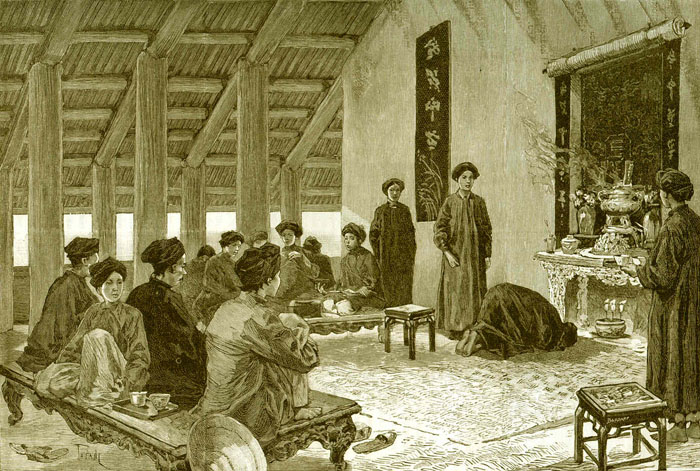
The khăn vấn is a long, thick rectangular textile coiled tightly around the head. The term vấn means to coil, and khăn refers to cloth or scarf. It covers the hair completely, creating a neat, structured look. Men wear it casually with one or two loops, while women may use padded hair underneath for volume. The style varies by region and social class, with specific pleat patterns on the forehead indicating different forms. It serves as both everyday headwear and formal attire depending on the fabric and wrapping method used.
Where it comes from
This headwrap emerged in Quảng Nam during the Trịnh-Nguyễn war, as locals adopted Champa customs. In 1744, Lord Nguyễn Phúc Khoát decreed that his southern court wear trousers and buttoned gowns, distinguishing them from the northern Trịnh Lords who wore loose skirts and long hair. Wrapping the scarf became a unique southern custom. By 1830, Emperor Minh Mạng mandated this dress code for all civilians, making the khăn vấn popular throughout Vietnam. It replaced earlier styles and became a standard part of Vietnamese identity during the Nguyễn dynasty.
What it means
The style signifies social hierarchy and regional identity. Yellow cloth was reserved for the emperor, while dark blue was worn by empresses and princesses. Pink was associated with singers and prostitutes, and other colours were common for general use. The quality and neatness of the wrap reflected personal dignity. In the imperial court, specific textiles like nhiễu cát indicated status. The shift from northern loose hair to wrapped heads marked a political and cultural separation between the Đàng Trong and Đàng Ngoài courts.
How it is made
For men, a cloth is wrapped once or twice around the head to secure a bun, forming pleats shaped like the characters for human (chữ nhân) or one (chữ nhất). Women’s formal versions, called khăn vành dây, use very long textiles folded to six centimetres wide. The edge faces upward as it coils around the head in a funnel or dish shape. The end is tucked into the back, sometimes secured with pins. Traditional fabrics like nhiễu cát provide elasticity and grip, preventing slippage without adhesive.
Who and what it suits
The style accommodates any hair texture, as the cloth covers the head entirely. Women often pad their hair to create a base for the wrap. The weight and thickness of the cloth must be balanced; laws prohibited wraps that were too short or thin, while excessively long ones were deemed ugly. It suits those seeking a structured, historical, or formal appearance.
Versions
In the Mekong Delta, the khăn rằn blends Vietnamese wrapping with the Khmer Krama, using black and white checks instead of red. Female styles include the khăn rí for daily wear and the elaborate khăn vành dây for nobility. Huế styles differ from northern ones, with edges facing upward and rings attached externally. Modern variants include pre-formed hats made of wood or plastic, though these are often criticized for lacking the aesthetic quality of traditional textile wraps.



Questions people ask about Khăn vấn
What is the difference between khăn vấn and khăn vành dây?
Khăn vấn is the general term for the head wrap, often used for casual or male styles. Khăn vành dây is a specific, formal variant for women and nobility, using much longer cloth wrapped in a funnel shape, often seen in imperial ceremonies.
Why did the style become popular in Vietnam?
It began as a local adaptation of Champa customs in the south. Later, Lord Nguyễn Phúc Khoát used it to distinguish his court from the north. Emperor Minh Mạng eventually made it mandatory for all civilians, cementing its place in national dress.
What colours were allowed for different people?
Yellow was restricted to the emperor. Dark blue was worn by high-ranking royal women like empresses. Pink was associated with entertainers and sex workers. Other colours were generally acceptable for the public, depending on social class.
Good reading and sources
The facts on this page come from the Wikipedia article "Khăn vấn", written by its contributors and used under the CC BY-SA 4.0 licence, and from its Wikidata record (CC0). EveryHairstyle rewrote the text in its own words, with AI assistance, and compares every page with the article to make sure no passage is copied. It may be reused under the same CC BY-SA 4.0 licence with a link back.
It may contain mistakes, and figures change over time. Nothing here is investment or buying advice. If something is wrong, tell us. Last refreshed 2026-11-15.
Like Khăn vấn
All covered and wrapped 🇮🇳 India and 3 moreDastar
A turban worn by Sikhs to cover uncut hair and signify faith.Wrapped · Any hair · 1699
 🇺🇦 UkraineUkrainian wreath
Traditional floral headdress for Ukrainian girls and unmarried womenWrapped · Any hair
 🇺🇸 United StatesTignon
A wrapped cloth headdress worn by Creole women in Louisiana.Wrapped · Any hair · 1786
 🇬🇧 United KingdomSnood
A net or cloth bag that holds hair at the back of the head.Wrapped · Any hair · 1590