
Mullet
An asymmetric haircut with short hair at the front and sides, and long hair at the back.
The mullet is a hairstyle defined by its contrast: short hair on the top and sides, and significantly longer hair at the rear. It has appeared throughout history among various cultures and saw peak popularity in the 1980s before experiencing modern revivals driven by irony and sports culture.
- The term was popularized by the Beastie Boys in 1994.
- Roman Emperor Tiberius wore long hair at the back.
- Peak popularity occurred during the 1980s globally.
- Phil Kessel helped revive the style in NHL hockey.
- A Guinness World Record exists for the longest mullet.
What it is
This style features a distinct difference in length across the head. The hair is trimmed short around the forehead, ears, and crown. In contrast, the hair at the nape of the neck is left to grow long. This creates an asymmetrical silhouette that ranges from subtle variations to extreme lengths. While historically worn by men, it has also been adopted by women and used within specific subcultures like lesbian communities for identification. The look can be styled straight or textured, but the defining feature remains the sharp contrast between the neat front and the flowing back.
Where it comes from
Elements of this cut appear in antiquity, with Roman Emperor Tiberius noted for long hair at the back. Ancient Britons and Byzantine factions also wore similar styles. In the Americas, Abenaki people were recorded wearing long hair behind and short hair in front. The modern term gained traction through the Beastie Boys in the 1990s, though the style was already widespread. It reached its zenith in the 1980s across the US, UK, and Australia. Rock icons like David Bowie and Paul McCartney wore it in the early 70s. A revival occurred in the 2010s via sports figures and again in 2020 due to lockdowns and ironic fashion trends.
What it means
The style carries varied cultural weight. In the 1980s, it signified mainstream rock and pop fashion. Within lesbian communities, it served as a public identifier. In recent years, wearing it has often become an ironic statement or a joke, as described by teenagers who view it as deliberately unpolished. Conversely, in Australian and New Zealand contexts, it became associated with the bogan subculture. In sports, particularly hockey in Pittsburgh, it represents local tradition and identity. Some wearers also appreciate its practicality for video calls, offering a professional front view while allowing casual styling off-camera.
How it is made
The cut requires precision to balance the contrasting lengths. The stylist trims the hair above the ears and across the forehead to a short length, often using clippers or scissors. The top section may be layered or kept flat. The crucial step involves cutting the back significantly longer, extending well past the shoulders. Variations include adding a rattail, which is a single long strand left at the nape. Modern interpretations often pair the long back with a taper fade on the sides for a cleaner transition. The hair can be washed, dried, and styled with minimal product to maintain the natural flow of the longer sections.
Who and what it suits
It is generally considered suitable for any hair type, provided the wearer is willing to manage the length difference. The style relies more on personal attitude and cultural context than on geometric suitability for facial structures. Individuals with straight or wavy hair may find it easier to maintain the shape, while curly hair might require more definition techniques. Ultimately, the look is defined by the willingness to embrace the asymmetry rather than specific physical traits.
Versions
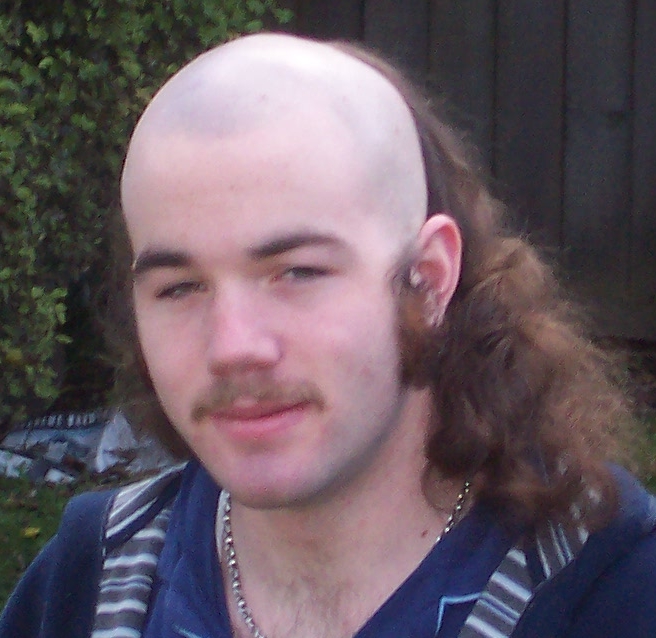
Several related styles exist alongside the classic mullet. The rattail involves leaving only one long strand of hair at the back, resembling a rat's tail. The skullet combines baldness on top with long hair at the back, famously worn by comedian Bill Bailey. Modern iterations often incorporate taper fades or undercuts to blend the short sides with the long back more seamlessly. These hybrid versions update the traditional cut for contemporary tastes. Other regional names include Hockey Player Haircut and Soccer Rocker, reflecting its adoption in sports cultures. The style continues to evolve with new techniques in barbering and styling.
In culture
The mullet has featured prominently in music and film. The Beastie Boys popularized the term in their 1994 song Mullet Head. Punk bands like the Vandals and Pansy Division referenced it in lyrics. Actor Kiefer Sutherland inadvertently boosted its fame after wearing it in The Lost Boys. In sports, players like Phil Kessel and James Conner revived it in hockey circles. Mexican singer Peso Pluma adopted it as a signature look in the 2020s. The style has also been banned in Iran as decadent. Competitions like the USA Mullet Championship celebrate it annually. Its presence in media reflects shifting attitudes towards gender norms and fashion irony.

Questions people ask about Mullet
Who made the name 'mullet' famous?
The American hip-hop group the Beastie Boys coined and popularized the term in their 1994 song Mullet Head. They also wrote about it in their magazine Grand Royal in 1995, providing alternative names like Hockey Player Haircut.
Is the mullet a modern invention?
No, elements of the style appear in antiquity. Roman Emperor Tiberius wore long hair at the back, and ancient Britons and Byzantine factions had similar cuts. Native American tribes like the Abenaki also wore long hair behind and short hair in front.
Why did the mullet become popular again recently?
A revival began in the 2010s through sports figures and continued in 2020 due to lockdowns. People found it useful for video calls, looking professional in front while being casual in back. It is also worn ironically as a fashion statement.
What are some variations of the mullet?
Variants include the rattail, which leaves a single long strand at the nape. The skullet combines a shaved top with long hair at the back. Modern versions often use taper fades to blend the short sides with the long back for a cleaner look.
Has the mullet been banned anywhere?
Yes, the mullet was banned in Iran as part of a list of un-Islamic and decadent Western cuts. This reflects political and religious stances against certain Western fashion trends.
Good reading and sources
- Mullet (haircut) on WikipediaEncyclopedia
- More photos on Wikimedia CommonsPhotos
- Wikidata recordOpen data
The facts on this page come from the Wikipedia article "Mullet (haircut)", written by its contributors and used under the CC BY-SA 4.0 licence, and from its Wikidata record (CC0). EveryHairstyle rewrote the text in its own words, with AI assistance, and compares every page with the article to make sure no passage is copied. It may be reused under the same CC BY-SA 4.0 licence with a link back.
It may contain mistakes, and figures change over time. Nothing here is investment or buying advice. If something is wrong, tell us. Last refreshed 2026-11-15.
Like Mullet
All cuts 🇻🇳 VietnamCurtained hair
A parted fringe with short sides and back.Cut · Any hair · 1980
WorldFrosted tips
Short spiky hair with bleached ends.Cut · Any hair · 1998
 WorldShort hair
A general category for haircuts kept above the shoulders or chin.Cut · Any hair · 1920
 🇬🇧 United Kingdom and 2 moreUndercut
Long top hair with shaved or buzzed sides and back.Cut · Any hair · 1910
